
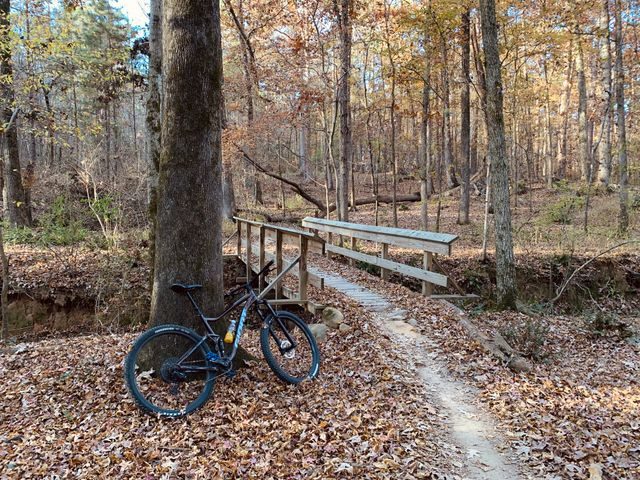
36 Hours in Bentonville
Last week, I had the opportunity to spend 36 hours in Bentonville, Arkansas, learning more about trail development and its economic impact. Most people know Bentonville as the home of Walmart, but among biking enthusiasts, it has become a destination in its own right, thanks to the immense infrastructure supporting all types of cycling.
As the self-proclaimed “Mountain Biking Capital of the World,” Bentonville caters to bikers in a way I have never seen before. The city is connected by trails, its concert venue has a dedicated bike parking lot, and there is even an office building with a bike path that winds up the side so you can ride to the sixth floor. The area also has a dedicated mountain biking park with a lift that takes riders to the top of the mountain, much like a ski lift.
What makes this particularly interesting is how recently Bentonville has transformed into a biking destination. It is a compelling example of what can happen when private and philanthropic funding, business interests and public infrastructure goals align.
For much of its history, Northwest Arkansas was relatively difficult to access. In 1990, regional business leaders, led by Sam Walton, formed the Northwest Arkansas Council to advocate for transportation, infrastructure and economic development. At the time, the region had no interstate access or regional commercial airport. That began to change with the opening of Northwest Arkansas Regional Airport in 1998 and a major interstate connection the following year.
Meanwhile, three major companies headquartered in Northwest Arkansas, Walmart, Tyson Foods and J.B. Hunt Transport Services, grew into Fortune 500 companies. Their growth increased the need to attract and retain talented employees, making quality of life an economic development priority rather than simply a community amenity.
Bentonville and the surrounding communities have invested heavily in creating a place where people want to live and work. Supported by significant philanthropic investment, particularly from the Walton Family Foundation, the region now has the world-class Crystal Bridges Museum of American Art, a regional greenway connecting its major communities, a vibrant downtown and an extraordinary network of trails. Bentonville alone has more than 80 miles of trails, connected to roughly 500 miles of trail systems across Northwest Arkansas.
What struck me most was how intentionally the trails have been integrated into everyday life. They are not simply recreational amenities. They connect neighborhoods, businesses and public spaces. They also support restaurants, hotels and other small businesses, and they make the area more attractive to visitors, prospective employees and existing residents.
Bentonville is a unique case, but there is a broader lesson in its transformation. Meaningful community change rarely comes from a single investment or organization. It requires a long-term vision and alignment among businesses, philanthropy, local government and community leaders.
I arrived in Bentonville expecting to learn about trails. Thirty-six hours later, I left thinking much more about economic development, philanthropy and the power of investing intentionally in place.
Meghan Potter